


If your child wakes at 3 a.m. crying or asking for a snack, you’re not alone. Henry Ford Health pediatrician Dr. Michelle Faber says the way parents respond can turn occasional wakeups into a nightly habit — what she calls the “hot fudge sundae” problem.
“If you woke up every night and someone handed you a hot fudge sundae, you better believe every night you would wake up for that hot fudge sundae,” Dr. Faber says. “After a couple of nights of not getting your sundae, you’re not going to wake up anymore.
“That ‘sundae’ is different for every kid,” she adds. “Sometimes it’s food, sometimes it’s attention from parents, sometimes it’s TV.”
Why kids wake up crying
Sleep regressions, illness or anxiety can throw off routines. Children also naturally stir between sleep cycles. While adults usually just roll over and drift back to sleep, kids who rely on outside help can’t always settle.
Common issues include:
- Habit hangups: Kids rocked, read to or cuddled to sleep expect the same treatment at 3 a.m. “This routine gets them sleepy, but it is not what parents should do in the middle of the night,” Faber says.
- Seeking attention: “The more attention we pay to kids when they wake up, the harder it is for them to go back to sleep.”
- Nightmares: For dream-related wakeups, Faber tells kids: “If you flip your pillow over, you won’t have another one because the bad dream is stuck on the other side.”
What to do in the moment
The goal is to help kids fall back asleep without assistance.
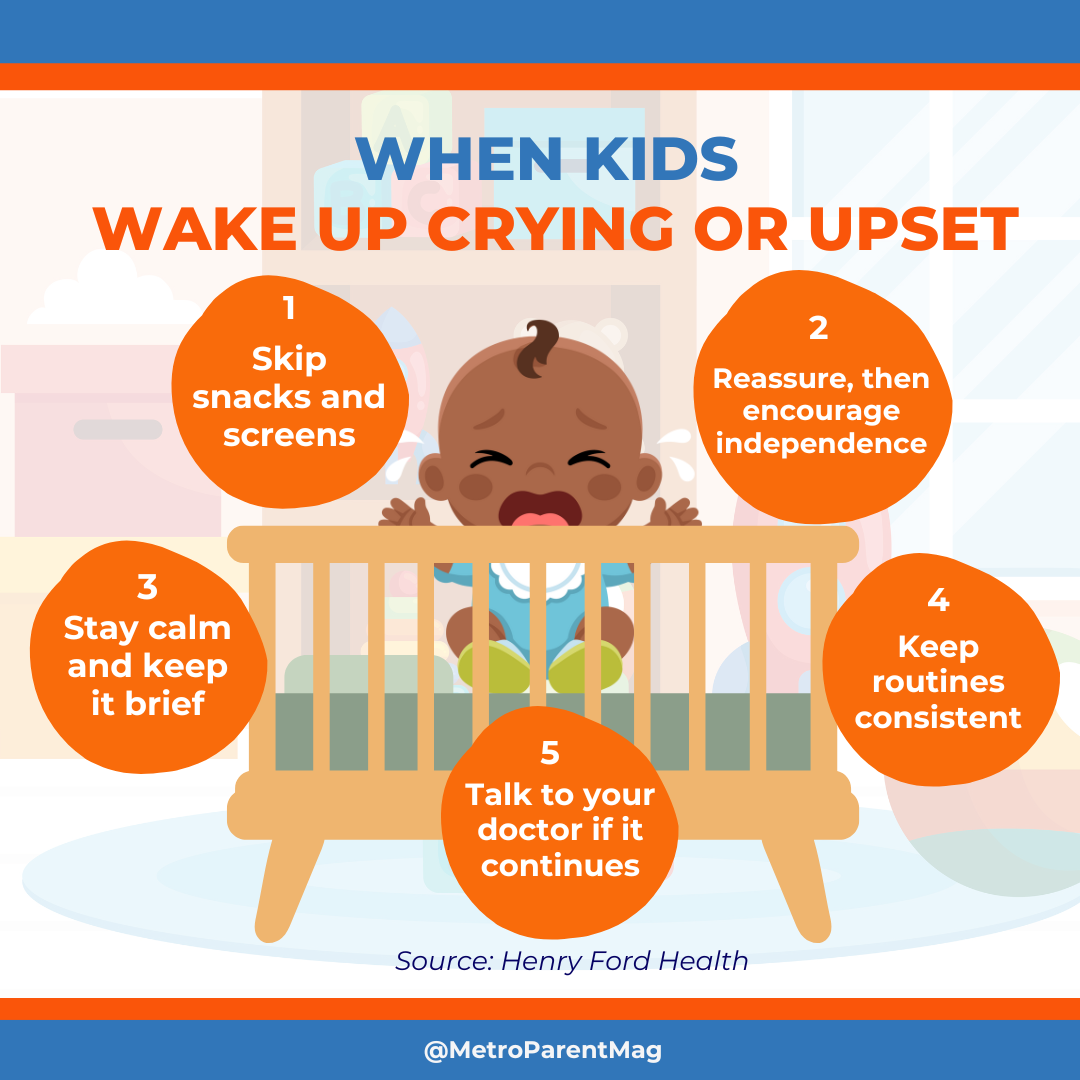
- Keep it brief. Go in, offer reassurance, maybe rub their back, then encourage them to settle on their own. “You want to interact with them the least amount possible.”
- Skip snacks and screens. “Once babies are a couple of months old, they do not need to be eating in the middle of the night,” Faber says. “If we put on the TV for them, they’re not going to be able to go back to sleep.”
- Stay consistent. Exhausted parents may give in and bring kids into their bed, but that often backfires. “We as adults are the biggest problems” when it comes to setting sleep expectations, Faber says. But the good news is, we can also be the solutions.
Tips for better sleep
Setting the stage for sleep matters just as much as how caregivers respond at 3 a.m.
- Limit screens for two hours before bed. Bright light disrupts natural melatonin production.
- Stick with steady routines. Regular sleep and wake times — even on weekends — make a difference.
- Aim for a dark, cool, quiet room. “The room should feel a little bit crisp. It shouldn’t feel stuffy,” Faber says.
- Try positive reinforcement. Sticker charts and (non-food) rewards can motivate younger kids.
When to call your pediatrician
Talk with your doctor if you notice:
- Loud snoring with choking or gasping (possible sleep apnea)
- Waking with headaches or vomiting
- Inability to return to sleep despite consistent strategies
- Night wakings every night for weeks, with daytime fallout
“Most sleep problems are behavioral and not medical,” Faber says. “But if it continues to happen, definitely talk to your doctor.” She adds, “I always encourage parents to talk to their doctor before giving their kids melatonin, because not all sleep issues are equal.”
Where metro Detroit parents can get help
Start with your pediatrician, who can guide you and, if needed, connect you with specialists such as ENT, neurology or sleep medicine for further evaluation.
For after-hours concerns, families can also call support lines, such as Henry Ford Health’s 24/7 MyCare Advice Line at 866-434-1372, where nurses are available to help decide whether your child needs to be seen right away or can wait for a next-day visit.
Getting kids back to sleep
Faber explains that young kids often test independence in three ways: sleep, eating and potty training. A 3 a.m. wakeup might be less about a bad dream and more about control.
With patience, consistency and a calm response, kids can learn to self-soothe. “If your kid is waking up and you can quickly settle them, it’s not a concern,” Faber says.
Reporting by Kim Kovelle
This content is sponsored by Henry Ford Health. For related content, visit Top Kids Health Questions Answered!