


What GPA do you need to get into college in Michigan? It’s a question that weighs heavily on students — and their parents. These days, college feels more competitive and expensive than ever. And many parents say they’re not sure they’d be accepted by their own alma maters if they applied today.
A new agreement between 11 Michigan public universities is changing that.
What is the Michigan Assured Admission Pact (MAAP)?
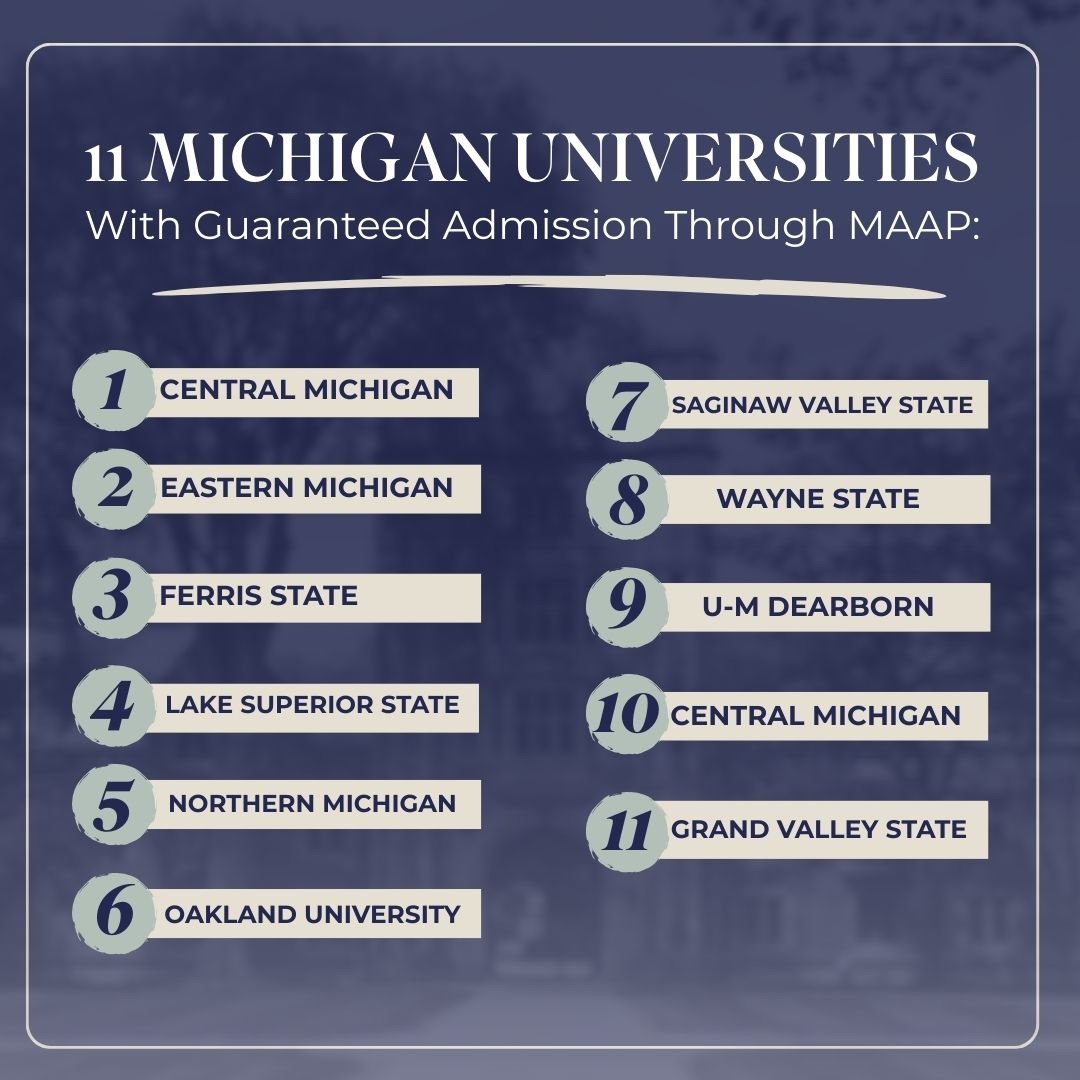
As of fall 2024, a new statewide agreement is making college more accessible for Michigan high school students. The Michigan Assured Admission Pact (MAAP) guarantees admission to 11 public universities across the state for students who graduate from a Michigan high school with a cumulative GPA of 3.0 or higher on a 4.0 scale.
Participating universities include Central Michigan, Eastern Michigan, Ferris State, Grand Valley State, Lake Superior State, Northern Michigan, Oakland University, Saginaw Valley State, University of Michigan–Dearborn, University of Michigan–Flint, and Wayne State University.
This pact removes a lot of the uncertainty for families navigating college admissions. And for metro Detroit families, it’s especially good news: Wayne State, Oakland, and UM–Dearborn are all right here.
What if my teen’s GPA is below 3.0?
A GPA below 3.0 doesn’t mean college is off the table. According to the MAAP website, some programs even grant admission with a GPA of less than 3.0 for some programs, so be sure to check.
It’s also important to know that while MAAP guarantees admission to the university, some selective programs or majors may still have additional requirements.
Your student will still need to:
- Apply directly to each school
- Submit any required documents (like transcripts or personal statements)
- Complete the FAFSA to be considered for financial aid
What else matters beyond GPA?
Even with a GPA guarantee, other elements can still play a role in admissions and future success. Colleges may still consider the difficulty of a student’s high school coursework, involvement in extracurriculars, and personal background. For example:
- Has your student challenged themselves with AP or dual-enrollment courses?
- Have they contributed meaningfully to clubs, sports, or community activities?
- Do they show potential in a specific field of interest?
MAAP simplifies the path to admission — but every student’s experience is unique and schools will continue to look at the whole picture when appropriate.
Why MAAP matters for southeast Michigan families
For parents in southeast Michigan, this pact offers a new level of clarity. Students who work hard and reach that 3.0 GPA milestone now know they’re eligible for admission at major local universities — without the stress of not knowing where they stand.
That gives families the freedom to focus on what matters most: finding the right academic fit, exploring programs and preparing for a successful transition to college.
In brief, here’s what MAAP means to your student
If your teen graduates from a Michigan high school with a cumulative GPA of 3.0 or above on a 4.0 scale and applies directly following graduation to one of the 11 participating MAAP public universities, they have an assured path to admission.
They’ll still need to submit the required applications and materials, and some programs may have added requirements. But now, the GPA piece — one of the most stressful parts of college planning — is clear.
For metro Detroit families, it’s a win: knowing that local institutions like Wayne State, Oakland University and UM–Dearborn are part of MAAP gives students meaningful options close to home.
This content is sponsored by Michigan Education Savings Program. Find more articles like this at Metro Parent’s Making Your Child’s College Dreams Come True.




 guarantees college admission for students with a 3.0 GPA — and what metro Detroit parents should know.)